Your equipment is shown under your inventory on the right. Click an item in your inventory to equip it.
- 1Main Hand
- 2Off Hand
- 3Ammo
- 4Head
- 5Chest
- 6Legs
- 7Gloves
- 8Boots
- 9Necklace
- 10Ring
- 11Ring
- 12Main Hand (alternate)
- 13Off Hand (alternate)
The Doors of Trithius has no attributes to raise. Your gear does most of that work: it decides how hard you hit, how fast you swing, and how much punishment you can take.
This guide covers equipping items, reading their tooltips, weapons and armor, carrying weight, and keeping everything in repair.
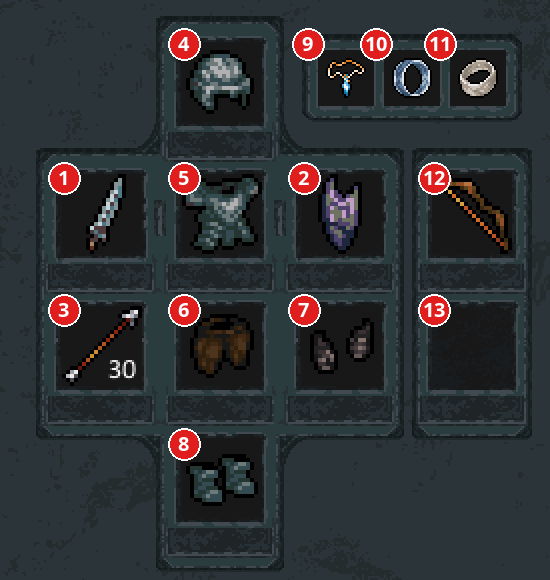
Your equipment is shown under your inventory on the right. Click an item in your inventory to equip it.
Hover over any item to see its tooltip. For weapons, the important parts are:
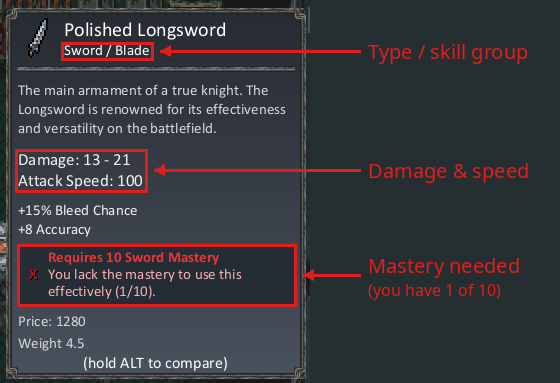
Every weapon type has its own mastery skill, and most belong to a larger group skill. Equipping or fighting with a weapon unlocks its skills, and every hit that lands trains them.
| Weapon | Mastery | Group |
|---|---|---|
| Dagger | Daggers | Blades |
| Sword | Swords | |
| Axe | Axes | |
| Mace | Maces | Bludgeons |
| Staff | Staffs | |
| Flail | Flails | |
| Bow | Archery | Ranged |
| Crossbow | Arbalism | |
| Fist Weapon | Unarmed (also used with empty hands) | |
Anyone can equip any weapon. But if your mastery is below the weapon's requirement, you become Inept with it: you lose accuracy and damage, and the penalty grows with every level you are missing. Early weapons have no requirement; the best need a mastery in the 40s or 50s.
The game doesn't show a tier number, but weapons are designed around six rough tiers of power. Materials in the name are a good hint, though plenty of weapons don't follow the pattern:
| Tier | Typical names | Mastery needed |
|---|---|---|
| 1 | Scrapwork, Rusted, farm tools | None |
| 2 | Experimental, Sharp, Sturdy | None |
| 3 | Masterwork, Steel, Ironwood | About 10 |
| 4 | Bonecarved, Bonewrought, Ashwood | About 20 |
| 5 | Adamant, Barbaric, Goldleaf | About 30-40 |
| 6 | Felforged, Bloodwood | About 45-55 |
Fist weapons need much less mastery than other weapons of the same tier. Browse every weapon on the Weapons page.
Bows and crossbows fire the arrows or bolts in your Ammo slot, and each shot uses one up. Crossbows must be reloaded between shots.
Armor comes in three rough types:
Compare a heavy chest piece with a light one:
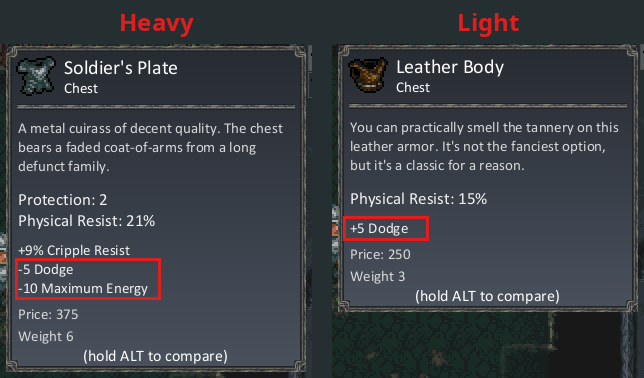
Heavier pieces can also lower your Move Speed and Maximum Energy. Nothing locks you into one style, so mix pieces freely and read the numbers.
| Stat | What it does |
|---|---|
| Protection | Removes a flat amount from every hit you take. |
| Physical Resist | Reduces physical damage by a percentage, after Protection. |
| Dodge | Chance to avoid an attack completely, set against the attacker's Accuracy. |
| Missile Deflection | Chance to deflect an arrow or bolt. Mostly found on shields. |
Every stat, with the items that carry the most of it, is on the Stats page.
Shields go in the off hand and add Protection, Physical Resist, Dodge and Missile Deflection. Bigger shields protect more, and slow you down more.
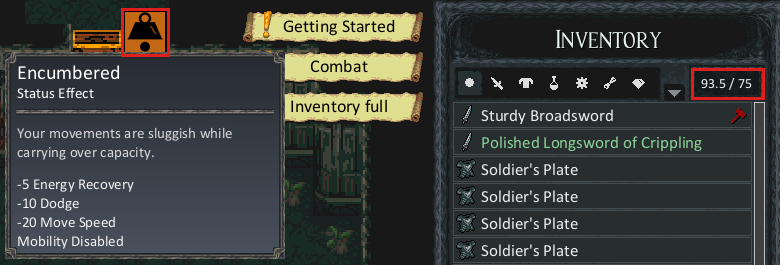
Everything you carry has a weight. The counter at the top of your inventory shows your total against your limit, which starts at 75.
Armor is the heaviest thing most characters carry. Sell or drop spare pieces rather than hauling them around.
Gear wears out with use. Your weapon wears when your attacks land. When you take damage, one random piece of armor or your shield wears.
| Condition | Effect |
|---|---|
| Good | Works normally. |
| Worn | Works normally. A warning that it will soon be damaged. |
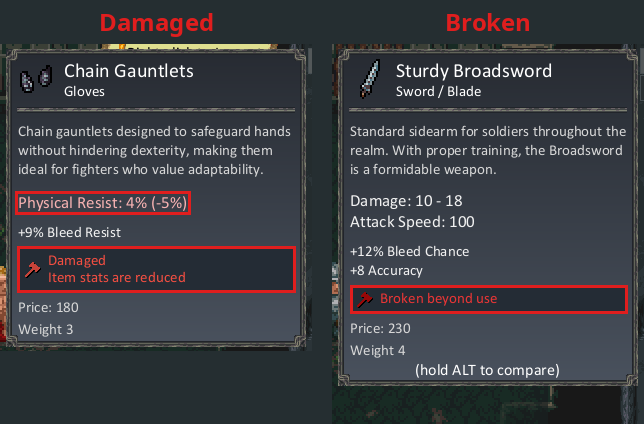
| Damaged | Its damage, or its Protection, Physical Resist and Dodge, are halved. |
| Broken | Unequipped automatically. Cannot be used until repaired. |
Items in poor condition show a red hammer in your inventory, and the tooltip says what state they are in. On damaged gear, the reduced stat is shown in red with the amount lost:
There are two ways to fix your gear:
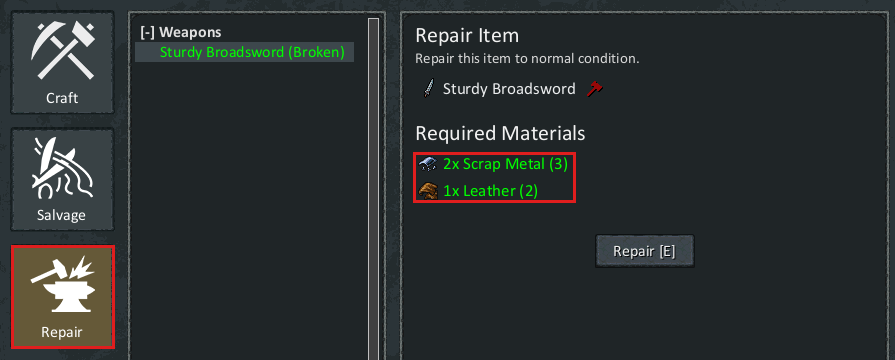
Shops will not buy anything below Good condition, so repair gear before you sell it. Gear you no longer need can be salvaged at a Workbench for materials.
On top of its base stats, an item can carry up to three extras, and they all stack:
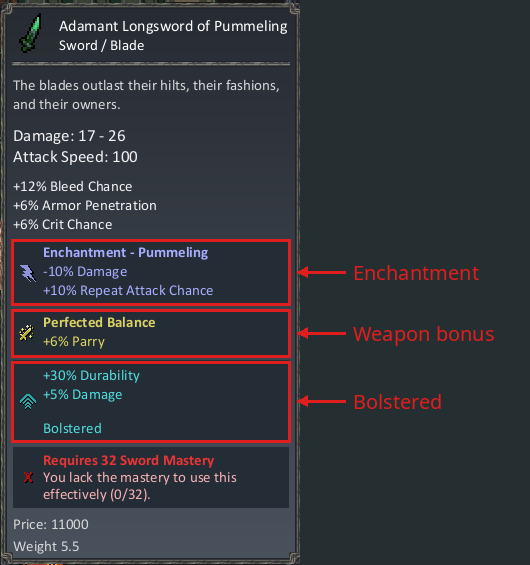
One per item. An enchanted item gets a new name, like Adamant Longsword of Pummeling, shown in color: green, blue or pink, from common to rare. Find enchanted gear as loot and in shops, or enchant items yourself with the Enchanting skill at an Enchanting Table.
Shown in yellow. A special bonus built into the weapon itself, so every copy of that weapon has it. Most weapons from tier 4 up have one.
With the Bolstering ability from the Quartermastery skill, you can reinforce a weapon or piece of armor once at a Workbench, for about twice its repair materials. It adds 30% durability, plus 5% damage on a weapon or 2% Physical Resist on armor.
Some monsters and potions can curse an item. A cursed item carries a penalty for as long as you have it, and shops will not buy it. A cleric can lift the curse.
| Shop | Sells |
|---|---|
| General Store | Basic weapons of every type, rings and necklaces |
| Smithy | Early weapons, armor and shields |
| Bladesmith | Daggers, swords and axes |
| Hammersmith | Maces and flails |
| Staffsmith | Staffs (Leafborn villages only) |
| Archery Supplies | Bows, crossbows, ammo and archer armor |
| Fightmaster | Fist weapons |
| Armorer | Armor and shields |
| Clothier | Light armor and clothing |
The strongest tier 6 gear is not sold in regular shops. Look for it from dungeon bosses, sanctums, traveling merchants, and the rare Weapon Maker, found behind a mysterious door.
Shops buy gear back for about half its price, and only the kinds of items they sell themselves.